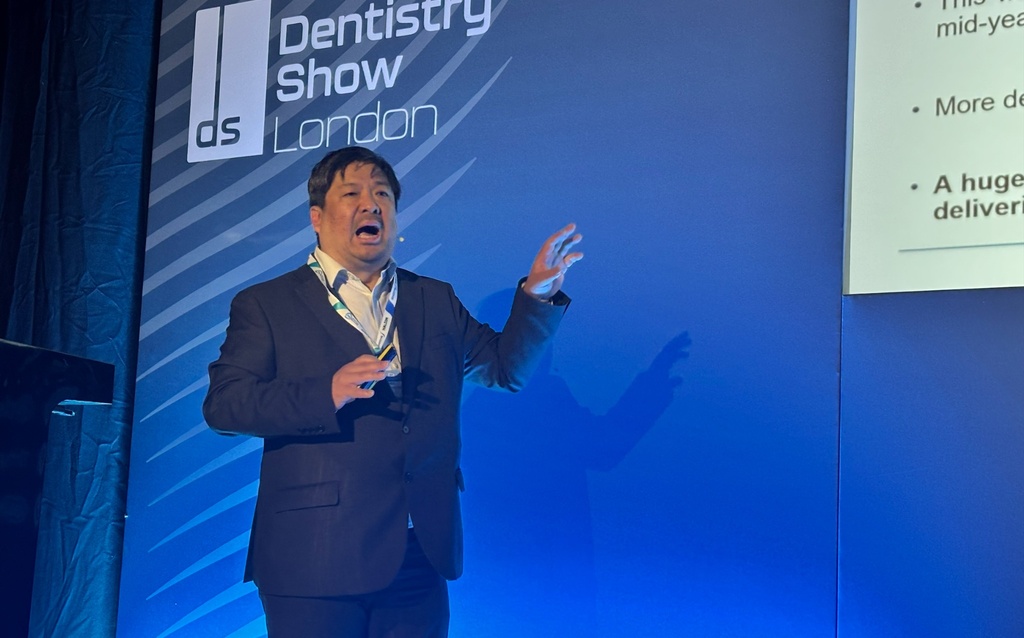
NHS England were wrong to label the new clinical pathways included in the current contract as ‘complex’, chief dental officer Dr Jason Wong said today.
Speaking at the Dentistry Show at the ExCel centre in London today, Dr Wong said that in hindsight the name ‘complex care pathways’ has given a wrong impression to the profession, and that in reality it is a large volume of work, but not complicated.
Dr Wong suggested that part of the problems in the implementation of complex care pathways (CCP) has been with the software being unable to keep up, but added that NHS England is in discussions with the software companies to update this.
He added that while there are currently three pathways, ‘there may be more in the future’.
However, profession leaders told GDPUK that the problem is not with the name, but is with the overly complex bureaucracy as well as confusion around what practices should be doing.
CCPs were introduced in the April 2026 contract and implemented in June. There are three pathways: pathway one is where there are five or more fillings needing treatment, which takes place over six months; pathway three involves patients with unstable periodontitis, which requires stabilisation and ongoing maintenance; and pathway two is for patients with both elements, with treatment lasting 12 months.
Instead of counting towards UDAs, practices receive payments of £293.40, £732.47, and £256.21 for CCPs one, two and three respectively.
However, they have been criticised by GDPs, with delegates at the LDCs Conference in Manchester labelling the initiative a ‘shambles’, pointing to a lack of guidance, uncertainty as to whether they were compulsory for relevant patients and worries around the increased paperwork burden.
At today’s conference in London, Dr Wong told delegates: ‘I now realise calling it “high complexity” was an error, but I really wasn't wanting to call it high needs. But, actually, the work isn't complex; it's just the volume of it and the fact that the patient comes in with certain things that affect the likelihood of them getting disease.
‘If someone comes in with a mouthful of decay or a mouthful of gum disease, we need to sort out the acute problem, stabilise them before you put in lots of work and lots of expensive work. The pathway is stabilisation. In fact, it's advocating for not doing the root canal during this time. It is literally to get the patient doing all the prevention - which everyone's calling for - and then having that in place. So significant caries, unstable periodontal disease, and there are many risk factors that could be in place.’
He added: ‘There are three currently, and there may be more in the future.’
There have also been concerns that some practices will be losing out on funding as a result of CCPs. But Dr Wong said: ‘I do recognise moving away from the UDA means that those with pre-existing high UDA rates may not be gaining as much as those who've got lower, but nevertheless, you know that's the equalisation of that. So, the care pathway guidance sets all this out, and the clinical philosophy underpinning this.
‘Most people are saying the clinical philosophy is sound. There's a lot of noise about the complexity or what the software is doing.’
Speaking to GDPUK after the talk, Dr Wong said that there had been some issues with the software companies being able to update their systems to incorporate CCPs, but added that discussions around this were ongoing.
However, Dr Eddie Crouch, chair of the BDA, told GDPUK: ‘I think the profession has lost confidence in this as being a solution, which is a massive shame really. The concept of it in the first instance was something that could have reaped quite a lot of dividends in being able to treat patients with higher needs with practices being appropriately remunerated.
‘But sadly, the red tape and the complexity that have being drafted in makes it very unattractive.’
Dr Mark Woodger, honorary secretary of Mid-Mersey LDC, said that the model remains an ‘unattractive’ one. He said: ‘The issues I commonly hear around the NHS care pathways are complexity of administration, and the fact the risks are still borne by the provider of care. Patients who need a lot of time can still cost the dentist and practice money to treat.
‘Alongside the additional administration required being unfunded, this makes them a very unattractive model. Additionally, treatment time and care is not linear, this can lead to challenges applying a whole team approach, or moving treatment between colleagues, while receiving payment in instalments.’
Meanwhile, Chris Groombridge, owner of 543 Dental Centre in Hull, one of the biggest providers of NHS dentistry, said Dr Wong’s comments were ‘fair’, and it was good of him ‘to acknowledge that “complex” in the name was probably not the best idea’.
However, he added: ‘Complex care pathways has come to stand for “complex care”, but it has also come to stand for “complex” to navigate the paperwork, frankly over engineered and to an extent showed a lack of trust by NHS England of the profession.’