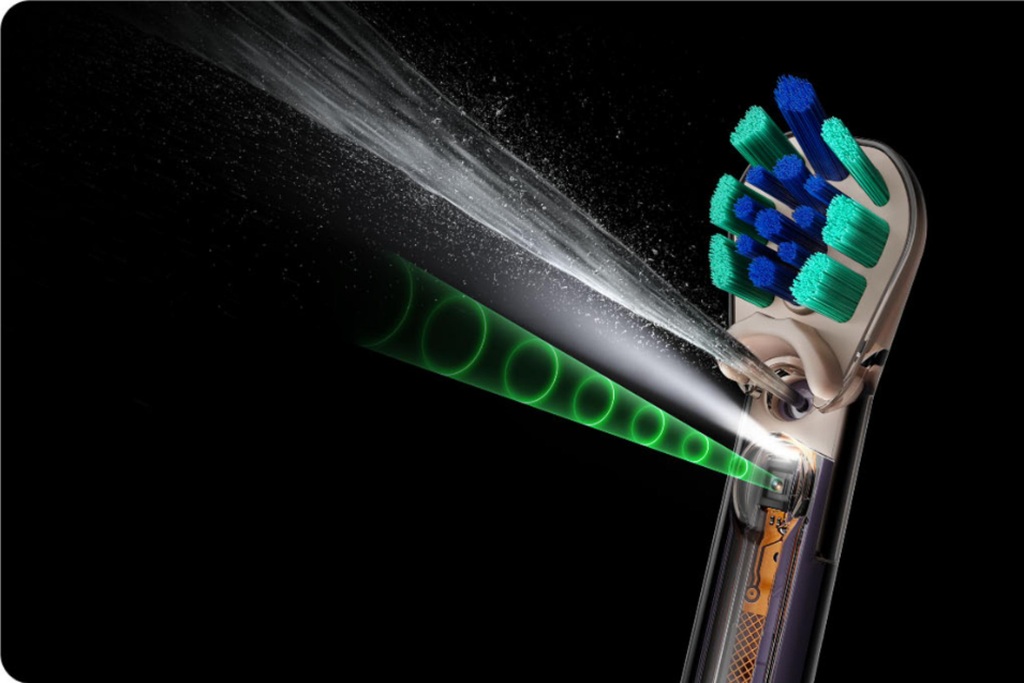
Dyson claims its AI-powered CameraJet brush will change the way we clean our teeth. But its roll-out has been hindered by faulty products and supply shortages. Can it still live up to the hype? Sophie Borland reports.
It’s been six years in the making, comes with a £419.99 price tag and has an AI-powered camera to record live footage from inside your mouth. But less than four weeks after the Dyson CameraJet’s heavily publicised launch, the brushes have seemingly vanished from UK shelves. The manufacturer has blamed ‘component issues’ and ‘shortages of supply,’ and says a new wave of products will be on sale soon.
Dyson became a household name over 30 years ago after transforming the way we vacuum our homes. Despite a shaky start, is it about to do the same for brushing teeth?
Contravenes NHS teeth-brushing advice
Dyson claims that one of the main advantages of the CameraJet is that it can target the gaps between the teeth, often missed during brushing, where plaque accumulates. This is because the AI-powered camera can detect where the gaps are located in our mouths, blast them with jets of mouthwash and remove the plaque.
But Dr Rachael Nichol, the president of the British Society for Paediatric Dentistry (BSPD), the national society dedicated to improving children’s oral health, tells GDPUK that the CameraJet may be contradicting the NHS’s ‘spit and rinse’ advice, pointing out: ‘By rinsing it immediately with a mouthwash, you are instantly washing away the fluoride.’
The CameraJet has had mixed reviews from dentists, consumer experts and journalists and while some have been impressed with its cleaning abilities, others have complained that it is too big, too messy and too complicated. Professor Damien Walmsley, an emeritus professor of dentistry at the University of Birmingham says: ‘It’s whether it’s just getting a bit too complicated. Each part of it sounds fascinating but putting it together in a power toothbrush could be a bit over the top.’
Mystery over ‘component issue’
Within a few days of its launch, customers were taking to online forums to report faults with their CameraJet brushes. These included charging problems, liquid seeping into the battery compartments and in some cases, the devices becoming completely unresponsive after a few uses.
The products now seem to have disappeared from Dyson online stores in the UK and around the world, although Dyson insists there has not been a product recall. At the time of writing, GDPUK found the product was listed as ‘out of stock’ on Dyson’s official website in the UK, France, the US, Australia and Singapore - the location of Dyson’s headquarters.
A Dyson spokesperson told GDPUK that a ‘small number of early batches of products have experienced a component issue’ and they were ‘seeing some shortages of supply.’ They said they expect new products to be ‘available in the coming weeks.’
We need ‘convincing clinical evidence’
While Dyson addresses its supply shortages and component issues, experts tell GDPUK they want to see hard evidence on its long-term effects on oral health.
Dr Victoria Holden, president-elect of the British Association of Private Dentists, says, ‘Before calling it a revolution…I’d want to see convincing clinical evidence of sustained improvements compared with established electric toothbrushes used alongside appropriate interdental cleaning.
‘I’m interested in seeing what happens to plaque levels and gingival bleeding, and whether people are still using it effectively once the novelty has worn off.’
Dyson claims the CameraJet removes 69% more plaque in hard-to-reach areas compared to other premium brands and says it is gentler on the gums and enamel. But this figure has come from Dyson’s own research in collaboration with the University of Singapore. Experts tell us they want to see independent studies from other universities.
Dyson and its billionaire founder Sir James Dyson are best known for launching the first bagless vacuum cleaner in 1993, which went on to become a market leader around the world. Their quick-drying hand dryers and bladeless fans, launched in 2006 and 2009 respectively, have also been very successful. But the company has also suffered some notable flops since including a washing machine whose two drums rotated in different directions, scrapped in 2005, an electric car project which was discontinued in 2019 because it was not commercially viable and the noise cancelling, air-purifying headphones, which were discontinued last year.
This will be Dyson’s first toothbrush and experts tell GDPUK there is already a very lucrative market of expensive, AI-powered devices. Others include Oral B’s iO10 at £800 and Philips’ Sonicare DiamondClean 9900 Prestige for £599.99, which both claim to give you personalised guidance whilst you clean. Dyson’s CameraJet isn't the only camera brush either - there is also the Feno smart brush, with a starting price of £276, which promises to brush your teeth in 20 seconds and provide personalised feedback.
Professor Damien Walmsley tell us: ‘It’s a very lucrative market for the big companies. People want to buy that, they think there’s something special with it. Some dentists are a little bit surprised that people will pay that money.’
But he adds: ‘No matter how much money you’re going to throw at it, you’re going to have to put the elbow grease in and your own dedication.’
His views are shared by Dr Eddie Crouch, chair of the British Dental Association, who is not convinced. He says, ‘Patients shouldn’t be lulled into thinking the latest gizmos will solve all their oral health problems. Big brands with high price tags are no substitute for a proper routine.’
Generated a discussion
Although there is limited evidence over whether the CameraJet will improve oral health in the long term and we don’t know yet if it will be a best-seller, experts say the hype around its launch has already had a positive impact.
Dr Victoria Holden says: ‘I’ve already been asked about the Dyson toothbrush quite a bit, so there is clearly public interest. That’s welcome, particularly if it gets people thinking about their oral hygiene.’
Professor Walmsley adds: ‘It’s generated all this discussion. It’s generated a conversation and will make more people think about caring for their teeth.’
A Dyson spokesperson said: ‘We have had a very positive reaction to the new Dyson CameraJet and are experiencing strong demand globally. We are seeing some shortages of supply as we are in the process of scaling up production, but we expect the next wave of product to be available in the coming weeks.
‘We are aware that a small number of early batches of products have experienced a component issue. We have isolated those batches and are taking all the necessary steps to support our customers.’