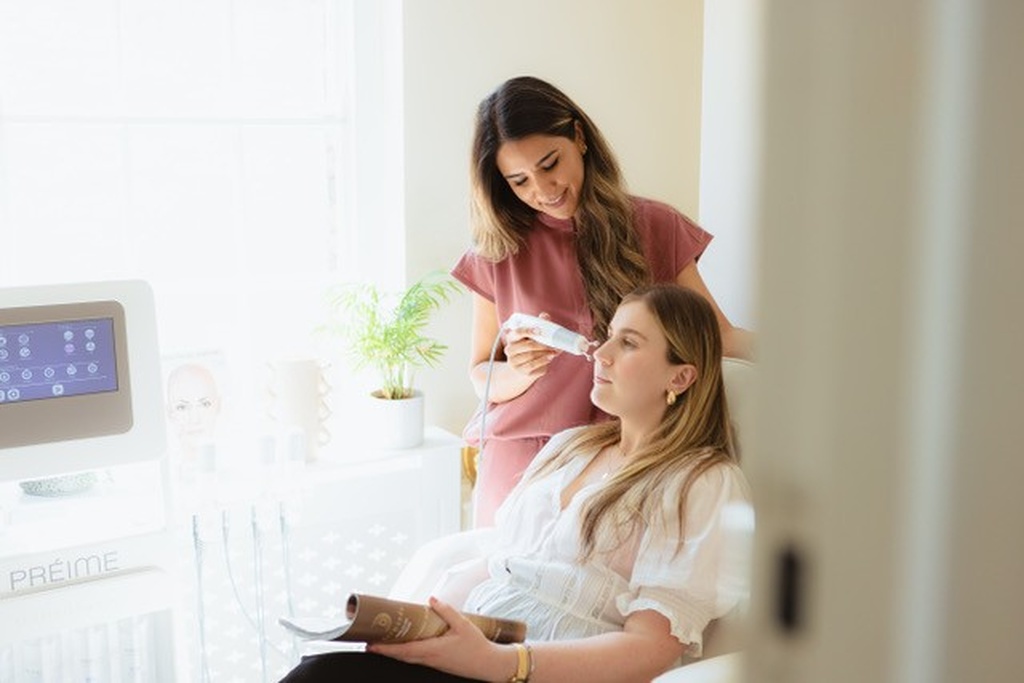
Dentists are among the most visible healthcare professionals on social media, with many practitioners using it as a tool to educate, market their services or attract patients, and many other uses. Our new series Dental Influential, on dentists with major social media, starts with a chat with Dr Shaadi Manouchehri, a dentist in Marylebone, London, who provides advice on oral health to her 373,000 followers on TikTok and 136,000 followers on Instagram.
Here, we discuss attitudes of colleagues, how social media is used as a marketing tool and more, and whether there is a danger in social media leading too many young dentists to go straight into cosmetic dentistry.
Did you start building your social media presence for your career, or were you always involved and adapted it for your career?
In terms of dentistry, social media was only really coming into play when I was in my final year of uni. Around 2018, when I first qualified, I thought I wanted to be an orthodontist, so I did the whole hospital training environment. Around then I also started a fashion page on Instagram, purely as a passion project. But nobody was making money from social media at that point and, being in a hospital training environment, social media wasn’t really going to help my career as far as I knew.
Then I got to thinking, if the likes of Dr Rhona [Eskander], George the Dentist [Dr George Cheetham] and the Singing Dentist [Dr Milad Shadrooh] - all successful people with little time to spare - are on social media, they must be getting something out of it; networking with other dentists, selling courses, getting patients. Around 2019, I decided to really start my professional social media; I booked a professional photographer and planned all my posts.
I posted my first post in February 2020, and very shortly after, lockdown hit. All of a sudden, we had all this free time - I had a lot more time and energy to just dedicate to my social media. For me, that time was spent on TikTok – back then, not many dentists were on TikTok. When you first start, you don't know what you're doing. So I started making videos of my cat.
Then I made one video about how I got into dentistry – a very basic video. Yet it got 80,000 views, which for me at that time was crazy. It got me thinking that there were all these students at home, people who would otherwise be doing work shadowing or whatever, and this is the platform that they now get information from, apparently. There were comments on that video asking more questions. It kind of grew from there.
At what point were you in your career ?
I stopped hospital dentistry in 2018 because I realised that I didn't want to do the hospital hierarchy. I went into practice - I knew I wanted to have my own practice at some point, I just didn't know when or how. But at that point, success in dentistry for me was working as much as I could clinically. I was young, I didn't have any commitments. I had a really nice job two days a week in a practice with a very small NHS contract, so it was mostly private. I loved it, but there wasn't capacity for me to grow there or do more days. I found another job, six days a week shift work. But when I started working there, it has horrible – a toxic practice environment. For a period of around three months, I was working 8am to 8pm, six days a week across two practices, including this toxic practice.
Despite doing so much clinical work, I was miserable and I wasn't progressing my career as much as I wanted because I was in such an unhealthy, toxic environment. I didn't want to grow. I didn't want to push the limits. I didn't want to do things that were new to me, treatment wise or whatever. It wasn't financially or otherwise beneficial to me being in that environment. So everything that I thought to that point was a lie. So I was like, ‘I'm going to do something entirely different. I'm going to go on social media and I just want people to know who I am’. That was the aim.
Your TikTok is far more about providing advice, whereas your Instagram is more a marketing tool for the practice. How do they feed into one another?
Before I had the clinic, I wasn't really looking to grow the business as such. I just wanted people to know who I was. I think it's really important to know what the purpose is of your social media activity, what your end goal is. Do you want to get patients? Do you want to sell courses? Do you just want to be an influencer? We're in a very lucky position in that all those areas could be streams of income for anyone if you work at it hard enough and enjoy it.
I'm fortunate that I have a team, but mostly we do the content on Instagram and that's very much promoting our services, the clinic. It's a much more polished version of everything and a lot more time goes into it. But I think the platforms are very different as well. I think on TikTok, what works really well doesn't work on Instagram.
As a dentist, I'm reviewing my purpose online all the time, and I think my main one is to genuinely educate. I'm really happy that that's working because I get a lot of patients to come to my practice or send me messages to say they've changed their oral health regime because of the videos that they watch.
How has your social media presence helped as a business, and how has it helped you as a practitioner?
As a business, I think everyone is realising the impact of social media and how well it can attract the right type of patients. I found quite early on that if you do a marketing campaign with paid ads or SEO or whatever, you're just attracting patients. Maybe out of 100 patients, one will go ahead because 99 of them won't be suitable. We tried one paid campaign with a company to help us, and got so many enquiries. But most of them were unsuitable, like somebody without teeth inquiring about a veneer consultation.
Whereas on social media, when you attract patients, it's patients that have seen your work, that have often been following you for a while. This is the feedback I get from patients: ‘I've been following you for about three years and I finally got the courage to book the appointment because I'm anxious.’ Nobody likes dentists - even I'm scared of the dentist! But seeing someone online, particularly seeing how relatable they might be, is a positive for patients. It's attracting the right type of patients to the practice and it's helped us grow as a business and I set up my entire practice as a squat with zero patients.
In terms of me as a practitioner, it's hard enough doing dentistry and liking the results yourself, or the patients liking the results. But to post it for all these judgmental people to see is a whole other thing, so it helps you to up your game. And then there is just connecting with people, seeing what they're doing.
What kind of feedback do you get from other dentists?
I think we're very lucky in that the dental community is quite close knit. A lot of us know each other, we might have worked together or gone to uni together. I would say the people that I've got the most support from is other creators. For exampla, Rhona invited me to her home, spoke to me about social media. To me,, she was a celebrity, she didn't have to do that. I was this young person coming on the scene and instead of seeing me as competition, she was happy to collaborate, help each other out.
When I first started out, I also had a podcast and that was a way for me to meet the influential people of dentistry and just talk to them, find out about what they did, what they learned from their journey, how they were so successful, and if they had any advice for younger dentists. I interviewed Dr Payman Langroudi (founder of the Dental Leaders podcast) - meeting these people, I was really starstruck. He later offered to sponsor the podcast, which was the first time ever I was making money from anything social media related. And again, those early supports really helped the trajectory and they helped introduce me to people and all of that. That was really monumental.
Unfortunately with social media, a lot of people won’t wish you well. My elder brother asked me ‘Are you okay with the judgement that will come? Because if you're not, you should not start.’
I didn’t know! I mean, how do you think about that? But you have to be able to take everything with a pinch of salt and just be mindful that, if a video is getting at millions of views, there are going to be people that are going to say things that are not so nice about you.
In one video that did well, I was using the interdental brushes between my teeth. I didn't think that was going to be a particularly controversial video, but a lot of people were criticising my gums, saying that I have black triangles or recession or whatever, and that what I'm doing isn't working. It got to a point where I messaged a periodontist friend of mine to ask ‘should I be doing this?’ He said ‘you're absolutely doing the right thing’. So yeah, it's just the combination of the public as well as the profession and it's just going to happen. You almost need to take it as a compliment.
Do you find any pushback from the older generations who didn't start their careers on social media?
Yeah, and to be honest, I get that. There was a lot of older generation dentists or people who'd done things differently who didn’t quite understand what I was trying to do. And that's okay. I felt a lot of, not judgment, but people saying ‘you can't do that, that's not going to work’. If anything else, this pushed me to prove them wrong. The way I've built my practice from scratch, from zero followings, zero social media, build a profitable practice in Marylebone on my own is a big deal in my opinion. I did it pushing boundaries and doing things people said you couldn't do and that brings me a lot of joy.
Do you sort of see social media as just being marketing?
It's a combination of things. First of all, doing those paid collaborations is part of my job. So as much as you want to attract patients with the advice type videos, it is my job to make those videos. That's why it's so important to have a purpose when you're starting out. What do you want to do? Do you want to sell courses? Do you want to attract patients? Do you want to get brand collaborations?
On a slightly more negative note, do you think that it might be pushing more younger dentists towards cosmetic dentistry, and harming other branches?
Possibly, yes. I was having this conversation this week, that the newer generation think that this is the dentistry that you start off with. They don't realise that we've been working in this field for ten years and we've done the bread and butter dentistry, we've done the boring fillings and the cleans and the checkups and all of that before you get into cosmetic dentistry.
But equally, it's good if people know what they want and they start early and start working towards that goal. We always say go to conferences, speak to people, do some shadowing, and if you know early on, it helps your trajectory in your career. So it can be negative, but I think it's more positive than negative.