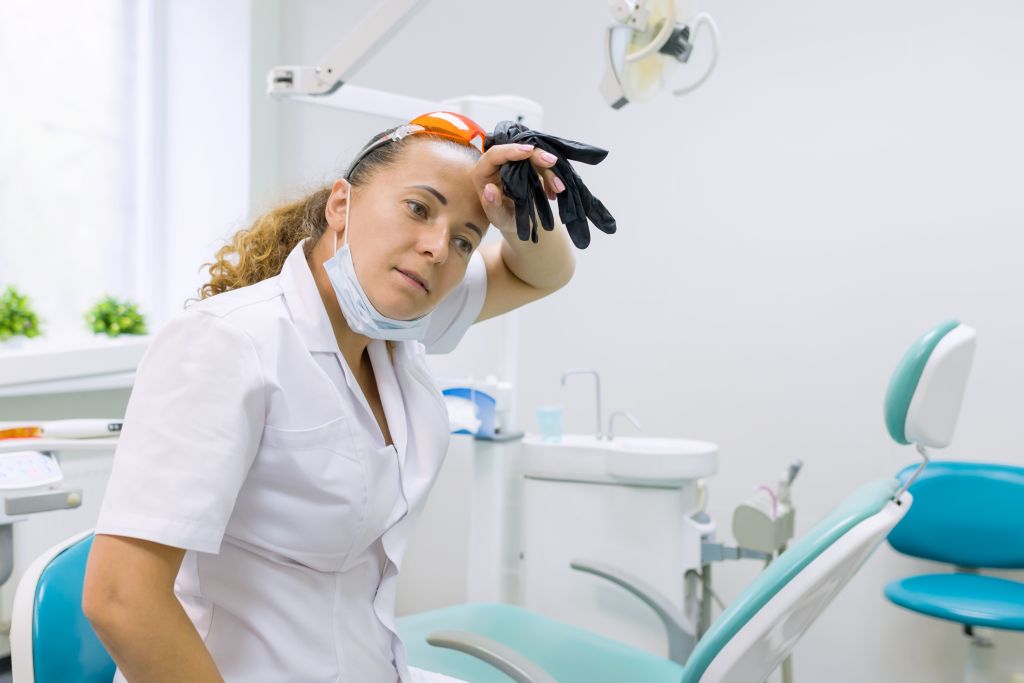
Have you ever considered why you write different length notes for different patients? Trained counsellor Vincenzo Iannone explains it might be due to the patient themselves
I have worked as a dental technician for 40 years, and I run my own laboratory in London. Every crown, bridge or denture that reaches my bench comes with a prescription: the dentist’s written instructions to the lab.
Over the years I noticed something I could not explain. Some of the dentists I worked with were always precise. One of them, whom I will call Dr S, never left anything to guess. Shade, margins and material were always clearly written.
But with certain patients, his prescriptions changed. Sometimes they became far too long: 20 lines, photographs, a phone call, and even details about the patient that I did not need. She is an executive. He is a professor. She is a politician.
With other patients the prescriptions became almost empty: a name, a tooth number, nothing else. When I phoned with a question, Dr S could not remember who the patient was, and answered with whatever came to mind.
Same dentist, same skills, same week. The only thing that changed was the patient. Over the years I saw the same pattern with every dentist I worked with. Something in the relationship with certain patients was changing the way the dentist worked, and neither the dentist nor the patient was aware of it.
I later trained in psychology and became a counsellor, and I began to understand what I had been seeing. This article is about that.
Patients with problems nobody has named
The title of this article asks whether we could be dealing with personality disorders. My answer is: more often than we think, and usually neither the patient nor the dentist knows it.
A personality disorder is not madness. It is a way of thinking, feeling and relating to other people that is more rigid and more extreme than most, that has lasted for years, and that keeps causing problems in relationships. The person usually does not see it as a problem. To them, it is simply how the world is.
These patients are not rare. The latest national survey of mental health in England found that one adult in five has depression or an anxiety disorder, up from one in six a decade earlier. One adult in seven screened positive for personality disorder traits. About two thirds of them were receiving no treatment of any kind, and fewer than one in twenty had ever been diagnosed by a professional. A screening test is not a diagnosis, but the scale is clear.
These people do not go to a psychiatrist. They go to work, they go home, and sooner or later they go to the dentist. Mind and mouth also tend to suffer together. In a study of more than 300,000 people in the UK, gum disease was linked with depression and anxiety. People with severe mental illness are more than three times as likely to have lost all their teeth.
In the practice we do not use clinical words for these patients. We use the words of the reception desk: 'arrogant', 'fussy', 'attention-seeking', 'doesn’t mind'. We see a difficult character. Often, behind the character, there is a real mental health problem that the patient lives with every day, at work and at home.
Why the dental chair makes it worse
These patients do not become unwell in the surgery. They arrive with the problem. But the dental chair turns it up.
Think about what a dental appointment asks of a person. They lie back, with their mouth open, unable to speak, in the hands of a stranger. And they are there because something in their body has gone wrong. For most people this is uncomfortable. For someone who is already fragile, it is a threat.
The psychotherapist Stephen Johnson describes what happens to personality under threat. A person may “function at the level of personality disorder when dealing with his key issues, when under extreme stress, or when given minimal support”. In plain terms: when a person’s sore point is touched, the pressure is high and nobody is holding his hand, his usual way of being becomes more extreme. Under threat, a character does not change into something else. It becomes more of itself.
A dental appointment can bring all three conditions together. So the patient who is demanding in everyday life becomes more demanding in the chair. The patient who usually makes himself small becomes almost invisible.
Two patients, one dentist
Two kinds of patient explain the two kinds of prescription I saw.
The patient we call 'arrogant'. She tells you about her position in the first five minutes. She wants the best, she knows more than you about your own work, and she questions your plan. Very often this is a person with narcissistic traits. Under the confidence there is usually a fragile sense of her own worth. She protects it by being treated as superior, and by treating the people around her as if they were there to serve her. Without ever saying it, she is asking: bow to me, be my subject.
The patient who 'doesn’t mind'. She asks for nothing. She agrees to everything, apologises for taking your time, and reception already knows that if her appointment has to move, she will not complain. Very often this is a person with avoidant traits. Deep down she believes she is not good enough, and she expects to be let down. She protects herself by asking for as little as possible. Without ever saying it, she is asking the opposite: don’t bother with me, I am not worth it.
What happens to the dentist
We all know that the atmosphere of a room can change when a certain person walks in. Psychologists call this emotional contagion: we pick up the moods of the people around us, mostly without noticing. Neuroscience has begun to show how it happens. In one experiment, people were shown angry or happy faces for a fraction of a second, too briefly to see them consciously. Their own facial muscles still moved to copy the expressions. When we watch someone we care about in pain, the parts of our brain that register how unpleasant our own pain feels become active too. Researchers have also described 'mirror neurons', brain cells that fire both when we act and when we watch someone else act, although how far this explains human emotions is still debated.
Now think of the dentist. She works a few centimetres from the patient’s face, for long periods, often with a person who is tense or afraid. The patient’s state of mind reaches her, and she absorbs it like a sponge. She does not choose this and she does not notice it. That is why I call it a spell.
Under the spell of the first patient, the dentist starts serving her. She gives extra time, explains more than usual, justifies herself, and writes a 20-line prescription with the patient’s job title on it. Under the spell of the second, she does the opposite. Fewer questions, a quicker shade, no photographs, a prescription with only a name. A week later she cannot remember the patient at all.
Neither dentist decided anything. Each simply gave the patient what she was silently asking for. This is unconscious collusion: an agreement between two people that neither has spoken and neither has chosen, and that damages both the work and the relationship. The dentist has been drawn into the patient’s psychological defences. The patient who needs to feel superior gets a servant. The patient who believes she is not worth attention gets none, and her belief is confirmed once again.
From the surgery to the laboratory
The spell does not stop with the dentist. It reached me and, through me, my staff. When a prescription arrived full of instructions and the patient’s titles, the whole laboratory found itself working extra hard for the important patient. When a prescription arrived almost empty, we had nothing to work with. In the end we neglected that patient too, and delivered exactly what she expected: something that was not quite right.
Poor lab prescriptions are a well-known problem. For 20 years, studies have found that around half of them arrive missing important information. In one hospital audit, only 28% were satisfactorily completed. The usual explanation is lack of training or lack of time, and both matter. But from my bench I saw another possible reason, alongside those. The same dentist could write a perfect prescription in the morning and an empty one in the afternoon. What changed was the patient.
The cost for the dentist
With both patients, the appointment seems to go well. There is no argument and no complaint, and that is exactly why nobody notices what has happened. But the dentist pays. With the first patient she spends energy she did not plan to spend: on serving, impressing and justifying herself. With the second, the work quietly goes less well, and she may meet the consequences later. Often she finds herself thinking about the first patient at home, and does not remember the second at all.
This is a kind of tiredness that the clinical workload does not explain. A day of ordinary cases leaves the dentist exhausted, because part of the work was emotional and she did not know she was doing it. Repeated over a career, this is one of the roads to emotional exhaustion and burnout.
What to look for
None of this means that dentists should diagnose personality disorders. That is not their job, and the patient does not need to hear it. But a dentist can learn to recognise when something in the relationship is pulling her away from her usual way of working.
The easiest place to start is her own paperwork. Take last month’s lab prescriptions and lay them side by side. If you normally write a clear, careful prescription, look for the ones that are much longer or much shorter than usual. Then ask yourself which patients they belong to. The answer may surprise you.
Vincenzo Iannone runs the New Smile Lab in London, New Smile Lab . He now offers counselling and courses for dental professionals on burnout and on the psychology of the dentist–patient relationship