
The GDC is once again acknowledging issues around the fitness-to-practise process following its latest survey. But, as Peter Ingle finds, this is something we have seen all too often
National Smile Month fell between 11 May and 11 June this year and can trace its history back to 1997. There isn’t yet an official ‘We know there are problems with Fitness to Practise but we are on the case’ day, but is fast becoming an established feature of the dental calendar.
September 2026 saw the GDC publish its Fitness to Practise Experience Survey Report 2026. This follows on from work commissioned by the GDC leading to the November 2025 publication Communication and Support in Fitness to Practise at the General Dental Council.
It might seem encouraging that the GDC are showing an interest in how the FtP process is working. The GDC would not want to be accused of marking its own homework and Manchester, Nottingham, Newcastle, and Queen Mary London Universities were all involved in both reports.
Over the last few years, the GDC insists it has been on something of a journey in terms of its relationship with registrants. Part of this has involved acknowledging that it has a bit of an image problem. It has taken a long time, but we are now at a point where senior GDC personnel can admit that it might have a chilling effect on those tasked with providing dental care in the UK.
Speaking in March 2025, GDC CEO Tom Whiting, said: ‘We have got to continue to improve fitness to practise and address the fear it causes. I have heard this message, as have my colleagues. And it is clear from our own research too. There are two different things here that are each very important. The FtP process has to improve, and the impact of the fear that it creates has to reduce.’
Which gives context to the latest survey from the GDC. On the GDC website, it was broadly welcomed: ‘We are committed to improving how we do things on fitness to practise but also how quickly we can resolve cases without compromising patient safety. Over the past few years, we have made some key changes. Whilst these changes have improved the fitness-to-practise process, we know there is more we can do.’
Registrants lack confidence in GDC
At first sight, a laudable approach from the GDC; accept that there is a problem, conduct some research, make some changes, measure the results.
The 2025 research made miserable reading for registrants. It referred to:
- Unclear expectations, infrequent updates and impersonal language.
- The processes were also seen as punitive which caused defensiveness and disengagement rather than early resolution or remediation.
- Participants were ‘lost in the process’ due to confusing formats, a lack of procedural transparency and inaccessible digital tools.
- Participants perceived that some less-well-served groups experienced inequitable treatment.
The latest report is an opportunity to see how the GDC’s efforts at making improvements are going. It found that most respondents remain dissatisfied and fewer than half believe it is fair, appropriate or proportionate.
The survey has some limitations. Responses ranged from 13% to 30% and it is not clear that they are necessarily a representative sample. In the absence of anything more rigorous, and given that it was commissioned by the GDC, it is likely to be used by them as a reference.
Overall satisfaction rates of both registrants and informants climbed from about 15% to 30% over the period surveyed. An ‘improved’ rate of just 70% dissatisfied is hardly a cause for celebration. Satisfaction with the outcome has fluctuated between 50% and 60% for registrants. This is also the percentage of registrants who felt that the process had taken too long. Perceptions of content and timing of communications showed little change.
One standout figure is that about 60% of registrants found that their initial communications from the GDC were unclear, showing that their difficulties with FtP start at the very beginning. This is a percentage that showed minimal change over the period surveyed.
In its discussion section the report noted that while longitudinal indicators suggested some improvement in some of the measures relating to the time taken by investigations, aspects of communication, and perceptions of the process, those trends were ‘not pronounced.’
Long-term concerns
The latest research covered cases decided between April 2022 and September 2025, but serious concerns about FtP go back much longer. The Professional Standards Authority (PSA), dates back to 2012 and oversees the ten statutory bodies, including the GDC, that regulate health professionals in the UK.
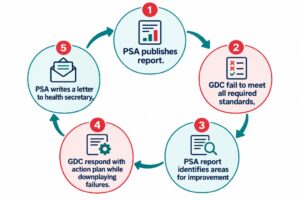
The PSA has produced comprehensive periodic reviews every three years into its regulators as well as shorter reports in between. In every single assessment since 2012, the GDC has failed to meet all of the required PSA standards. The GDC has been remarkably consistent in failing to meet the PSA standards relating to fitness to practice.
Over the years a general pattern has emerged, whose longevity could probably best be explained by a social anthropologist:
The GDC are fond of talking about trust. Indeed, establishing a relationship where it is trusted by the profession is now written into its strategy: ‘Our strategy for 2026–2028 is very consciously titled trusted and effective – this is what we are aiming to be seen to be and how your experience working alongside us should feel.’
It is notable that in his March 2025 comments, Tom Whiting identified two issues with Ft: the fear it engendered; and the actual process. To date the GDC have been more willing to accept the first of these issues.
Reaching out to the profession and acknowledging that the GDC is feared is a start, and represents progress from the Bill Moyes era (October 2013-September 2021). But acknowledging a problem is not the same as fixing it, as a profession that spends much of its time treating entirely preventable conditions will be all too aware.
The GDC’s own research has shown that those with the greatest exposure to the GDC tend to be least well disposed towards it. Seasoned GDC watchers still need convincing that the surveys, and even acknowledgment that there is a trust issue, do not simply represent deflection activity rather than a willingness to grapple with deeply embedded institutional failings.